 ChineseBoo
HSK Reading Practice: Build a Balanced Reading Routine
Combine materials for your actual HSK exam with regular Chinese reading. Use timed practice to understand the task, slower review to diagnose mistakes, and suitable stories to practise following connected text.
When a passage feels difficult, “read faster” is not a complete solution. You may be missing vocabulary, overlooking a contrast, confusing the people involved, or struggling with the question format. Identifying the obstacle makes your next study session more useful.
Start with the requirements for your exam
Check the official HSK information and your test centre for the version, level, format, and materials relevant to your booking. Do not assume an old vocabulary table or an app’s story level describes the current exam. This guide is a practice approach, not an official syllabus.
Use two kinds of reading session
For exam practice, use the instructions and time limit supplied with the relevant official sample or preparation material. Afterwards, review why each answer follows from the text. For general reading, choose a story you can mostly follow and take time to resolve a useful word or sentence pattern.
These sessions answer different questions: can you complete this exam task, and can you understand connected Chinese with growing independence? Keep both in your plan rather than expecting fiction alone to cover every test requirement.
Diagnose one missed answer
Consider 虽然下雨,他还是出门了 — although it was raining, he still went out. Knowing 雨 and 出门 is not enough if you miss the relationship signalled by 虽然 and 还是. After an error, identify whether the problem was a word, a relationship, or your interpretation of the question.
- Unknown word: check its meaning in that sentence, then find another example.
- Unclear relationship: mark cause, contrast, sequence, or condition and paraphrase the line.
- Misread question: compare exactly what was asked with the evidence you chose.
- Time pressure: try a comparable task after review and track accuracy as well as completion time.
A weekly plan you can adapt
Try several short reading sessions, a timed practice task, and brief vocabulary reviews. Adjust the amount to your schedule and the demands of your exam. If reviews crowd out reading, reduce new cards. If timed answers remain inaccurate, spend more time explaining the evidence instead of only increasing speed.
Choose graded stories when native fiction interrupts you constantly. When those feel comfortable, sample other topics and text types. Check vocabulary against your actual preparation materials rather than assuming every common story word belongs to a particular exam list.
Where ChineseBoo fits
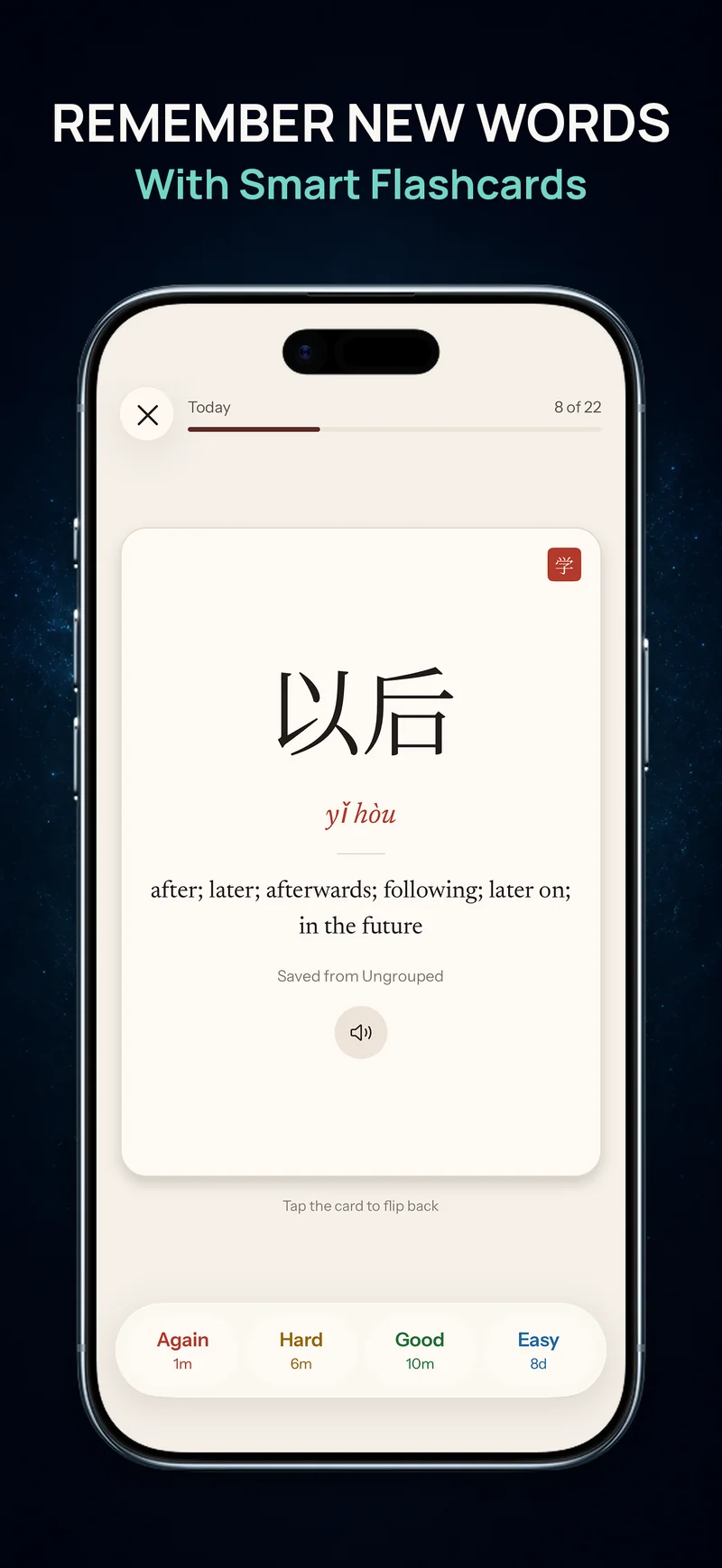
ChineseBoo brings graded stories, web reading, pinyin, and an offline dictionary together with flashcard reviews. Use translation and Ask AI to explore selected passages online, then reread the Chinese and revisit useful vocabulary.
Use these tools as supplementary practice. ChineseBoo is not an official HSK course, does not promise coverage of every level, and does not guarantee an exam result. Its role is to help you read and revisit useful vocabulary alongside the preparation your exam requires.
Add manageable reading to your study week
Read a graded story in ChineseBoo, check words beside the text, and review useful vocabulary. Make a little Chinese reading part of your study week.