 ChineseBoo
Using an AI Chinese Tutor While You Read
A dictionary tells you what a word means. An AI tutor tells you why the sentence works — and it never gets tired of your follow-up questions.
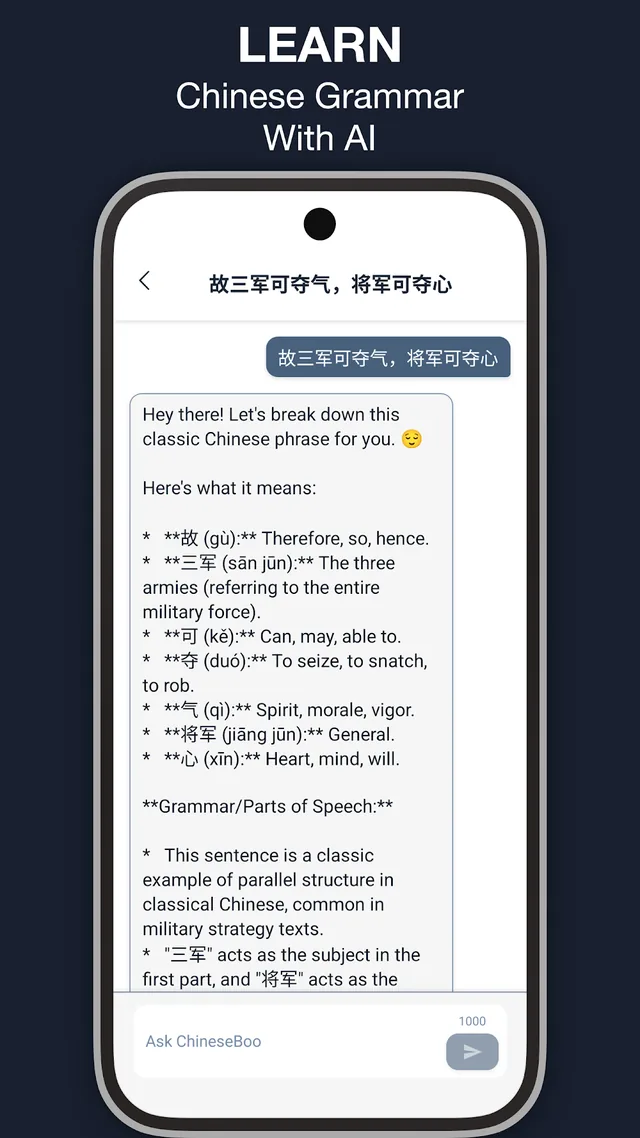
There's a category of question every Chinese learner carries around: Why is 了 here and not there? Is this word rude? What's the story behind this four-character idiom? Dictionaries can't answer these. Teachers can, but not at 11 pm, mid-chapter, for the fourth time this hour. This is precisely the gap an AI Chinese tutor fills.
What AI tutors are genuinely great at
- Word-by-word sentence breakdowns. Feed it 故三军可夺气,将军可夺心 and it will unpack every word — 故 (gù): therefore; 三军 (sān jūn): the three armies — then explain the parallel structure holding the sentence together.
- Grammar in context. Instead of a textbook's abstract rule for 把, you get an explanation of the exact 把-sentence in front of you, which is how grammar actually becomes usable.
- 成语 and cultural background. Four-character idioms compress whole stories; an AI tutor tells you the story, the modern usage, and the register — the difference between memorizing 成语 and owning them.
- Register and nuance. "Is 咱们 okay in an email?" "How harsh is 滚?" These judgment questions are where AI shines over static references.
- Infinite patience. Ask the same question five ways. Follow up. Go down the rabbit hole. No human tutor bills by the hour for this.
The honest limitations
AI models occasionally get things wrong — a rare word's tone, an overconfident etymology. Treat the tutor as a very knowledgeable study partner, not an oracle: for high-stakes translation (contracts, medical documents), use professional humans. For learning — where the cost of a rare imperfect explanation is low and the value of instant, contextual answers is enormous — the trade is overwhelmingly worth it.
Context is everything
Here's what separates a reader-integrated tutor from pasting into a chatbot: the passage travels with the question. When you select a sentence in ChineseBoo and tap "Ask AI", the tutor receives the exact text you're reading. You don't retype anything, and the answer accounts for the actual context — who's speaking, what tone the scene has, which sense of the word applies. Generic chatbots answer about a sentence; a reading tutor answers about your sentence.
Prompts that get great answers
- "Break this sentence down word by word."
- "Why is it 了 after the verb here and not at the end?"
- "Is this phrase formal, neutral, or slang? What would I say in casual speech?"
- "Give me two more example sentences using this pattern."
- "What's the story behind this 成语?"
A tutor that reads over your shoulder
ChineseBoo's AI chat receives whatever you select in the reader as context, keeps persistent sessions you can return to, and works alongside the tap dictionary, translation, and flashcards.


Where the tutor fits in the loop
Escalate deliberately: tap the popup dictionary for word meaning; select the sentence for a translation when the whole line resists; ask the AI when you understand the words but not the why. Then — this is the step that makes it stick — re-read the original Chinese until it parses on its own. The explanation was scaffolding; the re-read is the learning. That rhythm, repeated across a novel, is the fastest grammar course you'll ever take. See how it fits the full reading method.