 ChineseBoo
How to Read Chinese Web Novels (Even Before You Feel Ready)
Chinese web novels are the largest body of fiction ever written — and their repetitive, formulaic style makes them shockingly good language-learning material.
Chinese web novels (网络小说) are serialized stories published chapter-by-chapter on platforms like Qidian (起点中文网). They gave the world genres such as xianxia (仙侠, immortal heroes), xuanhuan (玄幻, eastern fantasy), and system/LitRPG fiction. Popular titles run to thousands of chapters — and only a tiny fraction ever gets an official English translation.
That's the frustration, and the opportunity: if you can read the originals, the entire catalogue opens up years before the translators arrive.
Why web novels are ideal for learners
- Extreme vocabulary repetition. Genre fiction runs on a compact core lexicon — 修炼 (cultivate), 突破 (break through), 灵气 (spiritual energy), 宗门 (sect), 境界 (realm). You'll meet each of these hundreds of times in a single book. Repetition is exactly what memory needs.
- Simple, punchy prose. Web authors publish daily and are paid by the chapter. Sentences are short, dialogue-heavy, and plot-driven — much easier than literary fiction.
- Endless motivation. A 2,000-chapter story you love is a multi-year supply of comprehensible input that never runs out the way graded readers do.
- Cross-checking exists. Many famous titles have English translations or wiki summaries, so you can verify your understanding when you start.
How hard are they really?
Honestly: the first fifty pages are the hardest thing you'll read. Expect an HSK 5-ish general vocabulary plus a genre vocabulary you won't find in any textbook. But the genre vocabulary is finite and front-loaded — most learners report that chapters 50+ feel dramatically easier than chapter 1, because the same words keep coming back. This is the repetition effect working for you.
If you're not there yet, spend a month or two on the ladder in our novels-for-beginners guide, then come back.
Where to read web novels
Read them where they're published: on the official platforms. Qidian and similar publishers make opening chapters of most novels freely readable, with later chapters unlocked through the publisher's own account, purchase, or subscription system. (Our Qidian guide covers the specifics.) Avoid pirate aggregator sites — quality is worse, and the authors see nothing.
Reading them as a learner, step by step
- Pick a famous title. Famous means proven story, existing English resources, and active fan communities. 斗破苍穹 (Battle Through the Heavens) is a classic first pick.
- Read the synopsis in English first. Walking in with plot context massively boosts comprehension.
- Accept fuzziness. Your goal is to follow the story, not to parse every clause. Look up what blocks you; skim what doesn't.
- Capture the recurring words. When you notice a word for the third time, save it to a flashcard deck — it has earned a place in your memory.
Read web novels with training wheels
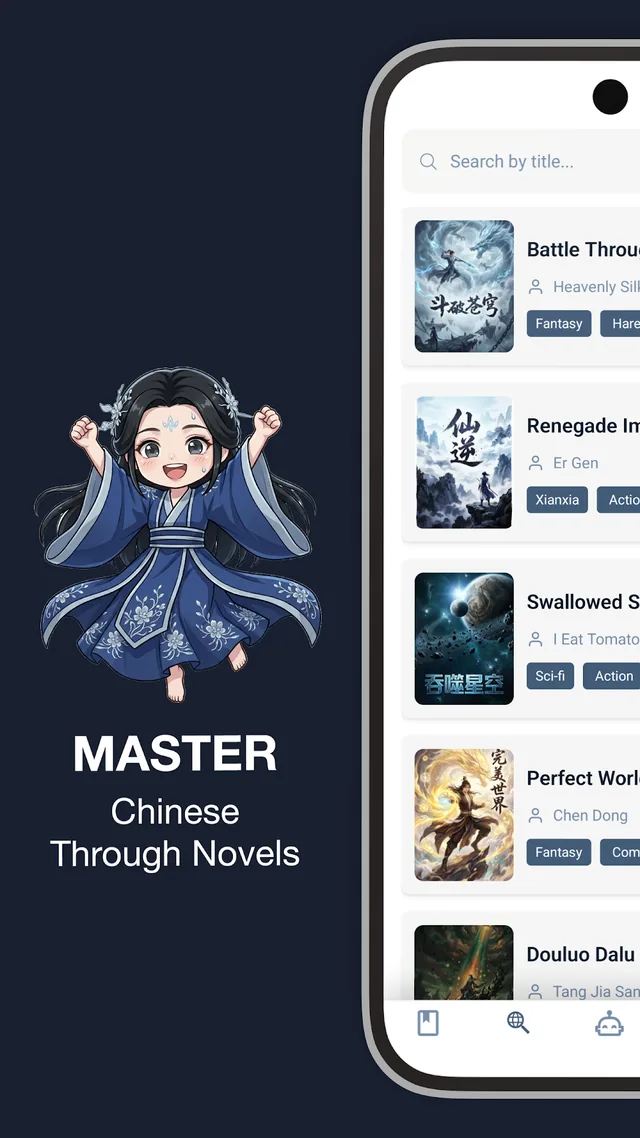
ChineseBoo's Discover tab is a curated catalogue of popular web novels. Tap one and the built-in browser opens the official publisher's site; Reader Mode reformats chapters you already have access to into a clean, tappable reading view with pinyin, an offline dictionary, sentence translation, and an AI tutor.


A note on doing this properly
ChineseBoo is a reading tool, not a content source: it doesn't host novel text, and Reader Mode never bypasses paywalls, logins, or any publisher access controls. You read what you legitimately have access to on the publisher's site — reformatted on your device for learning, the same way a browser's reader view works. Authors get their page views; you get a readable page.
The learners who succeed with web novels aren't the ones who waited until they were "ready." They're the ones who started messy, tapped a lot of words, and let a story drag them through five thousand pages of Chinese.